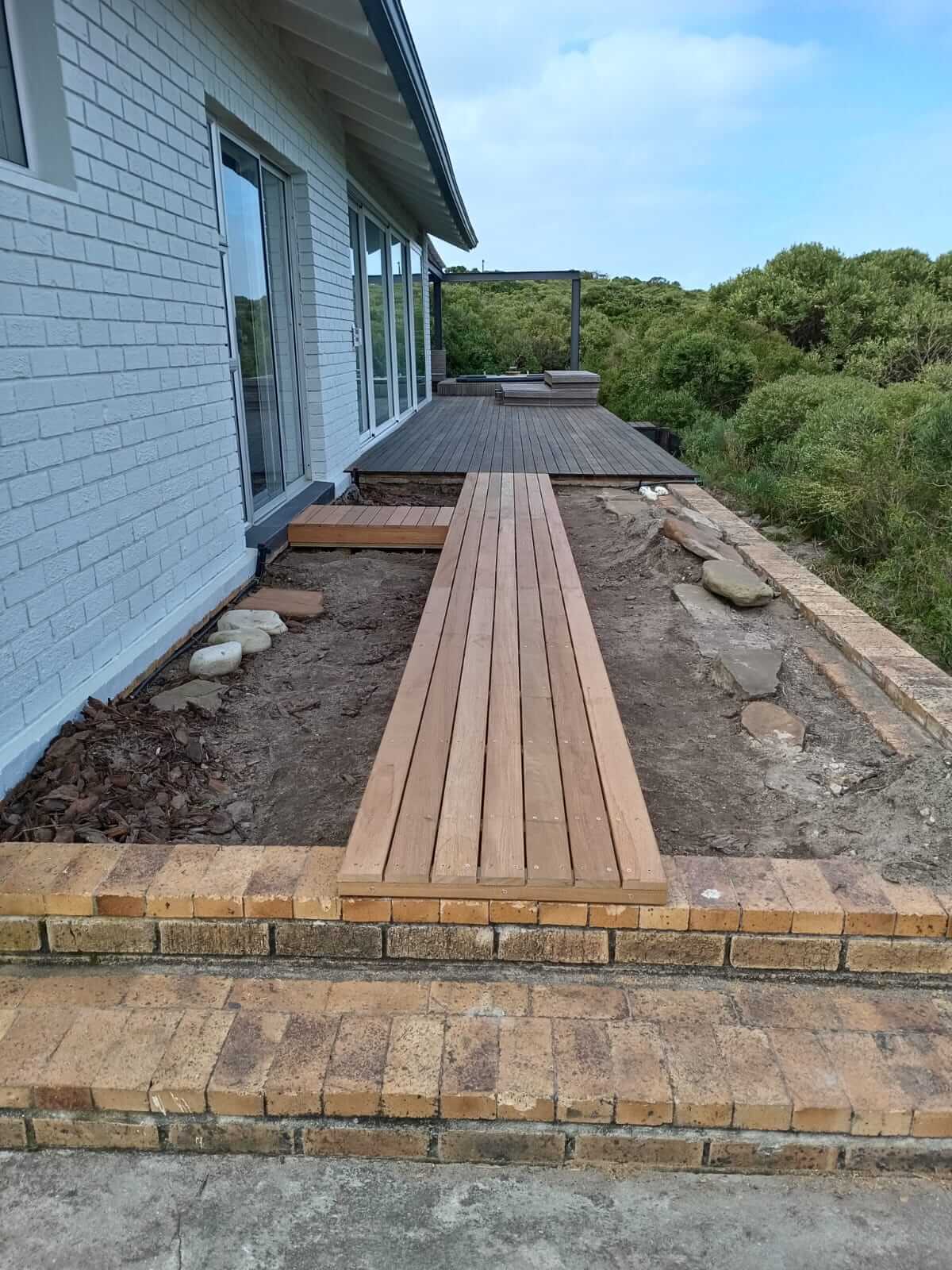
Every deck we build in Betty's Bay, Rooi Els, Kleinmond or Pringle Bay is fighting the same three things: salt-laden sea air, strong wind, and constant UV exposure. A deck design that works fine forty minutes inland doesn't automatically hold up out here. Getting the timber and the fixings right at the start is what separates a deck that still looks good in ten years from one that's peeling and rusting inside three.
Hardwood vs. treated softwood
Both have a place, it comes down to budget and how the deck will be used. Treated softwood (usually treated pine) is more affordable and works well for most residential decks, provided it's properly treated for outdoor, coastal use and maintained on a regular schedule. Hardwood costs more upfront but is naturally denser and more rot-resistant, and tends to need less frequent attention over its life. For a deck that gets heavy sun and salt exposure all day, hardwood is often the better long-term investment. For a smaller, more sheltered deck, properly treated softwood can be the more sensible choice.
Fixings matter as much as the timber
This is the part people usually overlook. Standard fixings that would be fine inland corrode much faster out here, and once a screw or nail starts rusting, it weakens the board around it and leaves ugly staining. Every deck we build uses stainless steel fixings for exactly this reason, it costs a bit more upfront but avoids a problem that would otherwise show up within a year or two on this coast.
Leave room for the timber to move
Timber expands and contracts with moisture and temperature, and it needs a small gap between boards to do that without buckling or trapping water. Boards laid too tightly together, especially treated softwood, are one of the more common causes of warping and premature rot we see on decks that weren't built with the coastal climate in mind. Proper spacing also keeps airflow moving underneath the deck, which matters more here than it would in a drier inland climate.
A realistic maintenance schedule
Whatever timber you choose, plan on sealing or oiling it more often than you would inland, salt air and UV break down a protective finish faster here. Rinsing off salt residue after a big southeaster and keeping an eye out for any fixing that's starting to rust are the two simplest things a homeowner can do between proper maintenance sessions.
If you're planning a new deck, or an existing one is starting to show its age, the best starting point is a real site visit, every property on this coast catches the elements slightly differently depending on how exposed it is. Get in touch and we'll take a look.